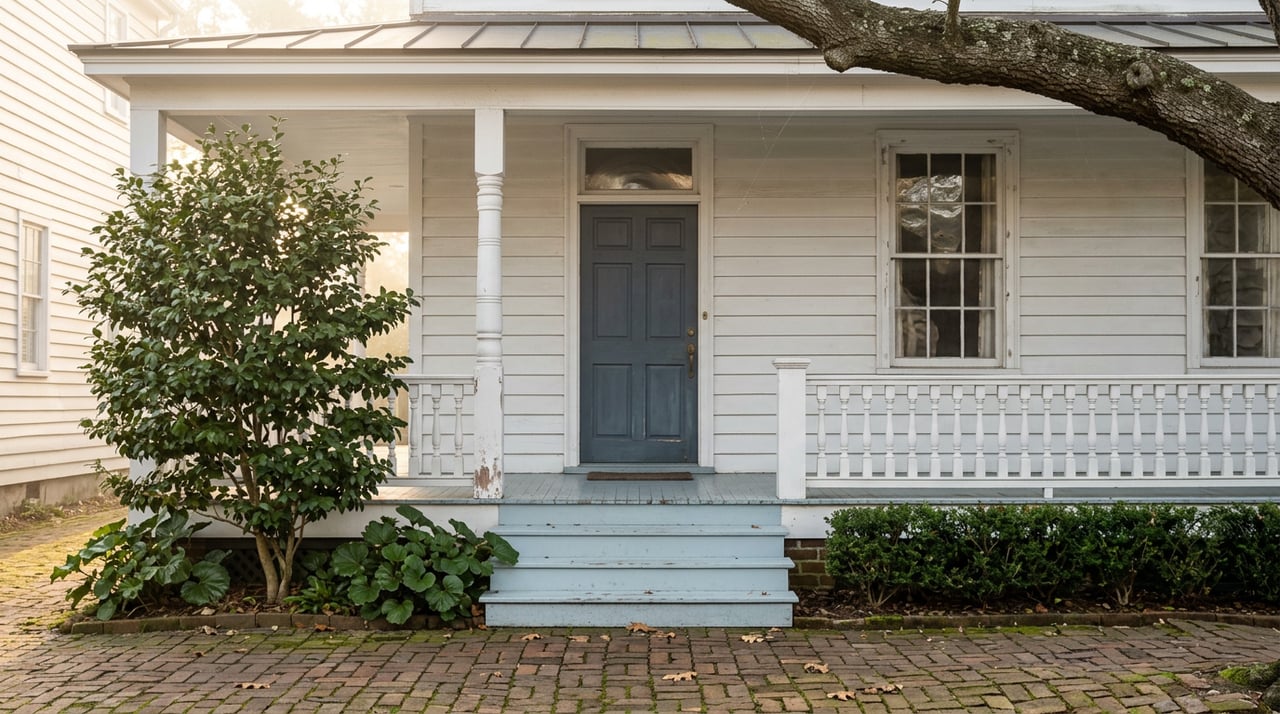
Ask a buyer touring a cottage on Nash Street what they expect from a historic district, and most will describe the same thing: a design review board, a waiting period, a form to fill out before you can swap a window or repaint a shutter. That expectation is reasonable. It is also, as of this summer, wrong for downtown Southport.
For nearly four years, the city was building toward exactly that kind of oversight. Then the state legislature stepped in and took the whole mechanism off the table. What's left behind tells you something worth knowing before you write an offer on an older home near the waterfront, and it isn't really a story about paint colors.
What Buyers Were Told To Expect
Southport's Board of Aldermen created a Historic Preservation Commission back in 2022, and the nine-member group, chaired by Fire Chief Charles Drew, spent the years since then drafting design standards for a proposed local historic district overlay. The map they produced covered 386 parcels along Bay Street, Moore Street, Nash Street, West Street, and West Brown Street, plus the commercial core and most of the original downtown lots, an area with architecture spanning more than two centuries, from Georgian and Federal to Queen Anne, Greek Revival, Craftsman, and Ranch.
Under that plan, a homeowner wanting to change a fence, remove a tree, or alter a walkway inside the boundary would have needed a Certificate of Appropriateness before pulling any other permit. That's the standard model for local historic districts across North Carolina, and it's what most buyers assume comes bundled with a historic-sounding street name.
What Actually Happened This Summer
The plan never got that far. A June 2, 2026 public hearing drew residents in shirts reading "Protect Property Rights" and "No HPC." A group of property owners, represented by attorney Samantha Richardson, sent the city a cease and desist letter warning that adopting the standards would amount to a regulatory taking. Weeks later, the North Carolina General Assembly ratified Senate Bill 876, a wide-ranging local laws measure signed July 2, 2026. Under Part XIII, the bill abolished Southport's Historic Preservation Commission outright and barred the city from ever creating a new historic district, or expanding an existing one, within its limits.
By July 7, city staff had introduced a replacement, a voluntary Historic Preservation Appearance Commission with no enforcement authority, and aldermen were scheduled to take it up for a vote on July 9. Southport now shares this constraint with a small number of towns where the legislature has directly overruled a local preservation effort, and downtown property owners are the ones living inside the outcome.
The Argument That Actually Killed It
The public debate sounded like a fight over aesthetics and property rights, and on the surface it was. But the argument that seems to have carried the most weight wasn't about shutters or setbacks. It was about financing.
Richardson's letter warned the city that full adoption would risk "a regulatory taking that would entitle a property owner to damages." That's the headline threat, but the more consequential claim sat right alongside it: even with a grandfather clause protecting existing properties from having to retrofit, a formal historic designation could cause an appraiser to flag a home as nonconforming, which in turn can make it harder to finance or sell. Whether or not that argument would hold up in every underwriting scenario, it's the one that reads as the actual mechanism here. A rule built to protect character can, in the eyes of a lender, look like a liability on the property it's protecting. That tension between preservation and financeability is the part of this story a buyer should sit with, because it doesn't disappear just because this particular ordinance did.
What's Left On The Ground
The Certificate of Appropriateness requirement is gone, and it cannot legally come back in its old form. In its place, the city has proposed an appearance commission that is advisory only. Homeowners will be encouraged, not required, to meet with the commission within 15 days of filing a renovation permit, and skipping that meeting won't delay the permit itself. There is no official document a homeowner needs before altering, demolishing, or building onto a historic property's exterior, and the commission has no power to stop any of it.
Practically, that means a buyer closing on a downtown Southport home this fall faces less regulatory friction on renovations than a buyer in almost any comparable coastal historic downtown in the state. That's a real advantage if your plan includes replacing windows, adding a porch, or updating a roofline before resale. It's also worth knowing that the character you're buying into right now is being held together by custom, not code.
Gwen Tanner, who has owned Mad River Design Studio for 30 years and has done extensive renovation work on Southport's older homes, made that point directly during the public debate, saying her business has thrived by voluntarily keeping with the spirit of Southport rather than because any rule required it. That's a fair description of how the town has actually looked for the 46 years since its original National Register listing in 1980, which carried no private renovation restrictions to begin with.
Two Designations, Not One
This is where buyers most often get confused, and it's worth untangling before you assume anything about a listing's paperwork. Southport has a National Register Historic District, listed in 1980, and a separate study boundary surveyed in 2010. National Register status is largely honorific for private owners. It doesn't require a Certificate of Appropriateness, doesn't restrict what you can do to your own exterior, and mainly matters if you're pursuing federal or state historic tax credits on an income-producing property.
The local overlay that just collapsed would have added the enforcement layer on top of that Register boundary, inside a narrower 386-parcel footprint. With SB 876 in place, that second, stricter layer cannot be created again under current law. If a listing description or a past disclosure mentions "historic district," ask which one it's referring to. The distinction determines whether you're looking at a designation with no teeth or one that, as of this summer, no longer legally exists.
What To Actually Ask If You're Looking Downtown
- Whether the home sits inside the 1980 National Register boundary, the 2010 study amendment, or both
- Whether any prior owner obtained tax credits tied to National Register status, which can carry its own paperwork trail
- Whether the seller or a past inspection ever referenced an anticipated Certificate of Appropriateness requirement that no longer applies
- Whether the appearance commission has been formally seated and whether the seller has had any advisory contact with it
None of these questions require a lawyer to ask up front. They just require knowing which designation you're actually dealing with, since the two get conflated constantly in casual conversation around town.
Why This Isn't Fully Settled
Southport's relationship with the state legislature on land use has been rocky for a couple of years now, with the state eliminating the city's extra-territorial jurisdiction in 2024 and allowing a handful of properties to de-annex in 2025. The historic district fight fits that broader pattern. The current appearance commission is a compromise born out of a specific legal threat and a specific legislative session, and Southport's local government could still revisit how that advisory body functions, even if it can't rebuild the enforcement mechanism the state just eliminated. If you're buying with a multi-year horizon, it's reasonable to expect this conversation to resurface locally, even though the legal door to a new mandatory district is currently closed.
A Few Questions Buyers Ask
Does this affect flood zone rules or building codes for older homes? No. This story is about aesthetic and design review authority, not flood elevation requirements or the building code itself, which continue to apply regardless of historic designation.
Can Southport pass a new mandatory historic district later? Under SB 876 as ratified, no, not a new one and not an expansion of the existing designations. That would require a future change at the state level.
Does buying in the old overlay boundary limit what I can do to my home? Not under any enforceable local rule as of this writing. The appearance commission's involvement is voluntary and advisory only.
If you're weighing a home on one of Southport's historic streets against something in St. James Plantation, Oak Island, or another Brunswick County community, the regulatory picture is only one piece of the comparison, but it's one that's easy to get wrong from a distance. Vic's Picks has been walking buyers and sellers through the specifics of these neighborhoods for years, and we're glad to talk through what a downtown Southport address actually means for your plans, your timeline, and your renovation budget before you make an offer.